post image

Parkdale tenants demand no COVID evictions from MetCap and Golden Equity

QUEEN’S PARK RALLY JUNE 9 at 2PM SHARP!

This morning Parkdale tenants at 1475 King made the trip to Scarborough to deliver their demands to landlord Golden Equity. Tenants at 1475 King have been on rent strike since April 1 demanding Golden Equity negotiate with their committee regarding conditions at the building. Roger Steele of Golden Equity deferred to the building’s owners, but tenants made it clear they insist on dealing with the landlord as a group and that they will not accept COVID evictions now or ever.

A larger group of tenants from nine MetCap buildings in Parkdale marched on the local MetCap office this afternoon. When the local property manager refused to accept tenants’ demands, tenants reached MetCap CEO Brent Merrill by phone. Merrill responded to his tenants’ demand for no COVID evictions by claiming, “MetCap nothing to do with this”. Before hanging up on his tenants, Merrill lied saying he has no power to take evictions off the table for tenants unable to pay rent during the COVID crisis. Adding further insult, MetCap then called Toronto Police Services. Four TPS officers were quickly deployed in response to tenants attempting to collectively deliver a demand letter.


Today Parkdale tenants resolved to expand our organizing and escalate our actions. Parkdale is home to tens of thousands of working class people facing the same struggles, Toronto home to hundreds of thousands. We know we are not alone in our buildings, neighbourhood, and city. But we also understand that for us as working class people our collective strength is accessed by organizing together. At the end of today’s access we safely distributed Keep Your Rent newsletters to share with neighbours in our buildings. We also committed to joining with tenants from across the city on June 9 at Queen’s Park to demand no COVID evictions.

post image

June 9 Queen’s Park Rally: No COVID Evictions. Not now, Not ever

On Tuesday, June 9 at 2:00 PM sharp, tenants from across the GTA will come together at Queen’s Park to demand that there be no evictions for unpaid rent during the COVID-19 crisis. Not now. Not ever.

Join us at Queen’s Park and send a message to the government, landlords and our fellow tenants: we will never accept COVID evictions. We will organize to protect the health and homes of our neighbours and make sure that none of us are left behind.
__________

* Background: The Ontario Superior Court may have temporarily suspended eviction hearings but there is nothing that protects tenants from COVID evictions once the suspension is lifted. No commitments have been made by our landlords and no protection has been provided by the government. Many of our neighbourhoods have seen the highest rates of job loss and COVID infections in the province. For months now thousands of tenants in Toronto have had little to no ability to pay rent and stay safe. For those that have fallen behind, paying back rent will be a crushing debt sentence they may not recover from. All while eviction, homelessness and the risk of infection hangs over our heads.

* Pre-rally actions: In the week leading up to this rally, tenants across the city are encouraged to plan actions confronting their landlord. Demands will be delivered to their offices and homes. Mass call-ins will be organized. Landlords will be put on notice.

* COVID precautions: Social distancing will be strictly followed. This means 2 metres (6.5 ft) of distance between each person at all times. Masks are mandatory. If you can, bring your own. If not, masks will be available. COVID-19 has hit our neighbourhoods the hardest and we refuse to increase that threat. For months, we have organized in our buildings and neighbourhoods with health and safety in mind. We will continue that in a disciplined fashion at this action.

post image

RANEE LANDLORD BEN FRIEDMAN INVOLVED IN 100+ LONG-TERM CARE DEATHS!

We re-publish this report from People’s Defence Toronto.

While organizing over the past two months, we have been horrified by news of mass COVID-19 outbreaks at long-term care homes. Recently, we found out that some of the worst hit homes are owned by the same person sending eviction notices and rent increases to hundreds of tenants without jobs and income.

Ranee Management Limited is a corporate landlord with over 7,500 units throughout the GTA. Ranee is run by the Zolty-Friedman family dynasty, which has been profiting off real-estate schemes for over 60 years. Phyllis and Bentzion (Ben) Friedman – the daughter and son-in-law of Ranee’s founder Morris Zolty – personally own several buildings, including those in Goodwood Park and Fountainhead Road which have been on rent strike since April and May 1st respectively.

Ben is also the president of Rykka Care Centres, one of the largest for-profit long-term care (LTC) operators in Canada. Three Rykka-owned nursing homes – Anson Place in Hagersville, Eatonville Place in Etobicoke, and Hawthorne Place in Jane/Finch – have had some of the worst COVID-19 outbreaks in the province, causing over 100 deaths so far.

Why? Because Rykka refused to put in place basic health and safety measures even as people were dying. PSWs, nurses and families of residents had to go to court to get any protection. Now, the military has exposed ongoing abuse and neglect in their homes, and the province is considering take-overs and criminal charges.

****
“I actually called the OPP, because I thought this was murder!” – Rebecca Shaw, PSW at Anson Place, on management’s handling of crisis

“My sister was traumatized by the way he died…it was a terrible death…he worked hard all of his life to bring up four children. He was a good man and he was a good father.” – Son of Maurice Orchard, first resident at Eatonville Place to die of COVID-19

“Protocols in place have a near 100 per cent contamination rate for equipment, patients and overall facility…Equipment is seldom/ever observed to be disinfected but is used between positive/negative patients.” – Military Report on Hawthorne Place, May 26th

****

HOW ARE RANEE TENANTS RESPONDING?

Tenants of Goodwood and Fountainhead are aware of Friedman’s heinous acts in Rykka, and are themselves victims of his greed. Before this pandemic, many of them faced constant rent increases while basic repairs weren’t done. Now, during the worst economic crisis in living memory, Ranee has used the threat of eviction to pressure them out of what little savings and income they have.

Hundreds have refused to accept these conditions. They want rent relief (not rent debt) for those who cannot afford to pay, and an end to rent increases in the coming months and years – including Above Guideline Increases (AGIs) of over 5% being pursued in two Goodwood Park buildings. They have taken up the Keep Your Rent Toronto campaign, and organized group chats and committees with the support of Tamil Freedom Coalition in Jane and Finch and People’s Defence Toronto in East York. They are on rent strike until Ranee stops threatening people with eviction, and acts like the “responsible landlord” it claims to be by negotiating with tenants.

For over 30 years, the wages, jobs and health of working-class people have been destroyed, while a small group of people have become unbelievably wealthy. This is at the root of the crisis in residential housing and long-term-care. Things will only get worse as this pandemic becomes a recession. The only chance of reversing it is if we get organized to fight back: in our buildings, workplaces and community networks.

With this understanding, tenants in Goodwood and Fountainhead will continue their rent strike into June, and take on concrete acts of solidarity with residents and workers at Rykka-owned homes. Follow the PD page for updates!

post image

Stop the Eviction Bill

Emergency Action: Text Doug Ford now at 416-805-2156 or email him at doug.fordco@pc.ola.org to ask why he is making it easier for landlords to evict tenants in the midst of a global pandemic that has made paying rent impossible for tens of thousands of tenants across Ontario.

Ford Goes Behind Tenants’ Backs To Weaken Tenant Protections

Today, the Conservative government made clear why the Landlord and Tenant Board and repayment plans are no solution for tenants. This afternoon, without notice, the Conservative government brought forward a bill for second reading meant to amend the Residential Tenancies Act. The vote for this bill, ironically titled “Protecting tenants”, will occur tomorrow morning around 11:30 AM. While tenants have been waiting for a meaningful response to the rent crisis amid the COVID-19 pandemic, the provincial government has instead chosen to attack tenants further.

Bill 184 aims to speedup evictions by limiting tenants’ legal defenses and in some cases removing the requirement to hold eviction hearings. Previously, renters were able to raise issues like chronic disrepair at eviction hearings and the Board had discretion to deny eviction in cases where it found the landlord had not met its obligations. If Bill 184 passes, tenants would need to give notice in writing of these complaints before a hearing occurs. When landlords apply to evict tenants for late rent, the tribunal can make repayment agreements. Under the new law, if tenants are unable to fulfill those repayment agreements, landlords would not have to go back to the tribunal for an eviction hearing. Instead, the tribunal could issue a quick eviction order without a hearing.

In the absence of financial relief that surpasses the average rent for a 1-bedroom apartment in Toronto and in the face of attempts to make evictions easier for landlords, a clear message has been sent to residential tenants: We must organize with our neighbours. We must resist all attempts at eviction. And the Landlord and Tenant Board will not save us.

Tenants in Ontario are staring down the barrel of their third rent payment during the COVID-19 crisis. Not only have the difficulties we face been given nothing more than lip-service by provincial legislators and landlords, now we see a legislative initiative from the Provincial government that is a direct threat to tenants and a gift to landlords that want to kick us out of our homes.

Any attempt by landlords to evict tenants with the assistance of the LTB and the Provincial government during or immediately after this crisis should be understood by all Ontarians as sacrificing the health and safety of tenants for the profits of landlords.

We cannot wait for hearings at the LTB to take action. Ford has worked to ensure that landlords are provided added legal protection once the courts reopen while refusing to address the rent crisis under COVID-19. Tenants need a permanent ban on evictions for rent arrears during COVID. Tenants have been waiting for 2 months for their landlords to negotiate – and the only response from landlords and the government is an attack.

Ask Ministers and the press: “Why are premier Ford and the Conservatives making it easier for landlords to evict tenants in the midst of a global pandemic that has made paying rent impossible for tens of thousands of tenants across Ontario?”

Premier Ford 416-805-2156 @fordnation
Minister of Housing, Steve Clark 416-585-7000, 613-342-9522 @SteveClarkPC
CBC Toronto: (416) 205-5808
CityNews: (416) 599-2489
CP24: (416) 384-2400
Global News: (416) 446-5460
Toronto Star: (416) 869-4300

post image

Tenants from across the GTA Descend on Landlords’ Mansions

Today tenants from Scarborough, Mississauga, and Parkdale visited the homes of their landlords as the (virtual) annual general meeting of the Federation of Rental-housing Providers of Ontario (FRPO) was being held. No longer willing to endure landlords’ threats of evictions and demands of rent repayment, tenants took every safety precaution to collectively voice their demands for no evictions and for rent forgiveness for all tenants unable to pay during the COVID-19 crisis.

Our first stop was the home of Pinedale Properties CEO, George Grossman. Grossman’s company owns the buildings at 7, 9, & 11 Crescent Place where company reps have visited tenants’ units demanding on-the-spot rent payments with a handheld ATM. A company rep told one bereaved tenant whose relative had died from COVID-related illness that “COVID is nothing” and that “the economy needs to keep going”. This morning when tenants from Crescent Town attempted to deliver a letter to Grossman at his door they were greeted by a domestic worker employed at his residence. Grossman opted to cower inside his mansion rather than face his tenants.

Next we descended on the home of Starlight Investments CEO, Daniel Drimmer. In 2019 Starlight added to its real estate empire, buying GTA apartment buildings valued at a total of 3.75 billion dollars. Despite its growing financial power, in the past two months Starlight repeatedly sent notices to tenants demanding rent repayment and threatening to issue legal eviction notices. Shortly after we arrived Drimmer was seen pacing on his back patio while on his phone. Instead of talking to his tenants, Drimmer called Toronto Police Services and reported that tenants were engaged in “hate speech” against him.

Today tenants made it clear that we will continue to organize with our neighbours. Unless landlords’ threats of eviction and demands for rent repayment are withdrawn, and rent forgiven for tenants unable to pay during the crisis, we are prepared to escalate our action by bringing greater numbers of our neighbours to confront even more landlords where they live and do business.

For more information about Pinedale and Starlight visit www.landlordsoftoronto.com

Not yet organized with your neighbours? Visit www.keepyourrent.com

post image

What do I do if my Landlord…

DOWNLOAD THE FACT SHEET

CONTACT KEEP YOUR RENT

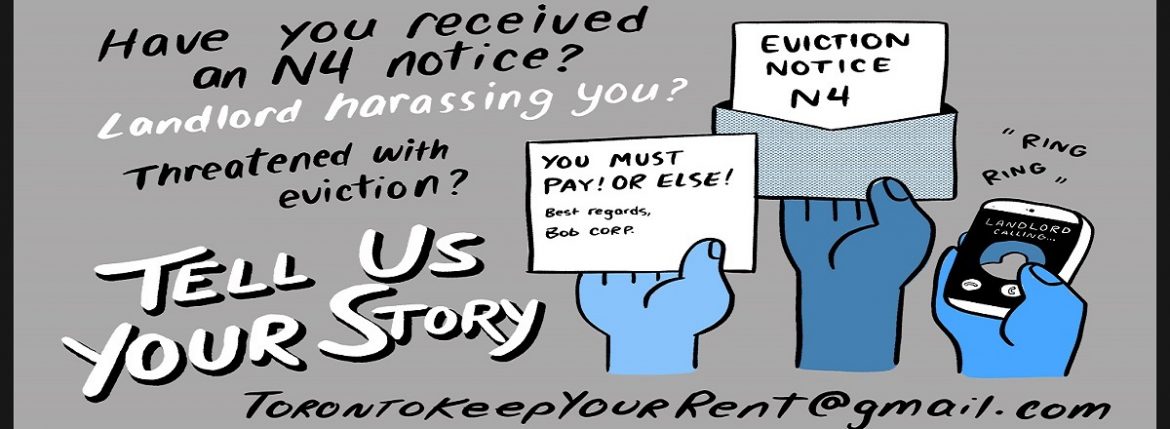
1.         Gives you an N4

Don’t move out. The notice is a threat but it is only the first step of the eviction process. Threats of eviction against tenants are unacceptable, especially during a global pandemic. You’re not alone.

Contact your neighbours and Keep Your Rent to plan a collective response against landlords who threaten tenants with eviction.

You will see on the N4, it states that if you do not pay the money you owe the landlord within 14 days of the date of the N4 that the landlord can apply to the Landlord and Tenant Board (LTB) for an eviction hearing. Hearings are typically scheduled 4-6 weeks later. At a hearing, the landlord will make their arguments about why they are owed the money and why the tenant should be evicted, and the tenant has an opportunity to make their counter-arguments (Note: if your matter proceeds to the point where you receive a Notice of Hearing from the LTB, contact your local community legal clinic immediately: https://www.legalaid.on.ca/legal-clinics/).

Due to the COVID-19 pandemic the LTB is currently not scheduling eviction hearings or issuing eviction orders at this time other than in “exceptional circumstances”. Even if an eviction order is issued, the Ontario Superior Court has temporarily suspended enforcement of those orders. For the time being tenants cannot be lawfully evicted.

2.         Doesn’t give you an N4

Some landlords may not issue N4s if tenants agree to rent repayment. Or, they may wait to issue N4s later on. This is a set up. You are under no obligation to agree to repay now. Tenants who agree to rent repayment now may find it harder to obtain a cancellation of rent later. 

Contact your neighbours and Keep Your Rent to plan a collective response to landlords who pursue collection of rent from tenants who can’t afford it during a global pandemic. For tenants who feel they may be in a position to pay their rent – keep in mind the fluidity and constantly-changing nature of this issue. Money in hand today may be worth a lot more tomorrow.

3.         Sends you harassing or threatening messages

Threats and harassment are unacceptable. We believe tenants have the right to their home free of any harassment from the landlord. The Residential Tenancies Act, provides protection from tenants to live free from harassing or threatening behaviour from their landlord and their landlord’s representatives. That being said, as is discussed above, the LTB is not currently scheduling hearings. Therefore, for tenants who want to pursue legal remedies, this is unlikely to take place any time soon, and the results are often far less than what tenants hope for. 

Contact your neighbours and Keep Your Rent to plan a rapid, collective response. Document your landlord’s behaviour

4.         Shows up at your unit

Barring some kind of emergency, there is no reason for a landlord to show up to your unit. By showing up at your unit the landlord is putting you at greater risk of exposure to COVID-19. If your landlord insists on showing up at your unit, contact your neighbours and Keep Your Rent to plan a rapid response. Record any interactions where it’s possible to do so safely. If your landlord calls the police, do not be afraid or intimidated. Police have no right to intervene in landlord-tenant matters (a civil matter), unless there is otherwise criminal conduct taking place. 

Contact your neighbours and Keep Your Rent to plan a rapid, collective response. Document your landlord’s behaviour

5.         Illegal Lockout

The only way a landlord can legally remove you from your home is with an order from the Landlord Tenant Board and the only person with the power to enforce that order is a Sheriff. Only you and the sheriff have the legal authority to remove you or your property from your home. Not the police, not special constables, not private security, and certainly not your landlord themself. Any attempt to remove you or your property or change the locks without an order from the Board is illegal.

But it happens. Tenants have come home to changed locks and their property on the curb. While this is illegal it is not unheard of, and almost only happens when a “small landlord” is involved.

So, what do you do if this happens to you or someone you know?

We understand that what we are about to say will be angering and even somewhat frightening, but please read through to the end.. Your legal options aren’t great, but we’ll lay them out for you anyways. You can contact your local Community Legal Clinic: https://www.legalaid.on.ca/legal-clinics/. They may advise you to call the police and ask for their assistance getting back in. It is common for police to decline this request. You can petition the LTB for an order to the landlord to allow you access to your home, but it is common for the LTB to only issue those orders after having conducted a hearing. And the LTB is mostly closed right now.

Tenants have a right to their homes, they have a right to safety from abuse and illegal acts from landlords. But the courts and police rarely act quickly if at all to protect those rights. So it may be left up to you and those you organize with to protect and defend those rights.

If you believe you may be at risk of illegal lockout, there are a few things you may want to consider doing:

1: Inform those that live around you that this may happen. Share with them a description of your landlord and give them your contact. If they see your landlord or anyone else doing anything suspicious around your home ask them to intervene and contact you.
2: Carry all important documentation with you at all times while outside the home. This includes identification, passport, credit and debit cards, immigration or legal documents etc.
3: Carry proof of residence. Ideally this would be your lease agreement but can also be registered mail with your name and address on it.
4: Leave yourself a way to re-enter your home or have a plan if locks are changed while you are out. A window or some other option may be necessary for you to be able to re-enter your home.

No matter which action you take if a landlord chooses to act illegally, the most important thing is to protect yourself. There is little better protection than the support of those you organize with. It is critical that we know all the possible outcomes and are prepared to respond accordingly.

6.         Calls Police

There is nothing criminal about keeping your rent. There is also nothing criminal about organizing with your neighbours in support of keeping rent. What about taking direction against landlords? Is there something criminal about organizing phone zaps or protests outside landlords’ homes?


The answer is no. The criminal law generally applies to conduct that causes harm to others. For example, if you punch someone you could be charged with assault. If you threaten to punch someone or to destroy their property you could be charged with uttering a threat. If you repeatedly say things to a person that makes them fear for their safety you could be charged with criminal harassment if that person’s fear is “reasonable.”


These examples share one common element – actual or threatened harm to another person. This element is missing from phone zaps, social media posts, and protests outside landlords’ homes or businesses. Actions like these are exercises in free speech and free assembly. They publicize tenants’ struggles while exposing landlords to the force of criticism and solidarity. There is nothing criminal about organizing or participating in these actions. So long as landlords are not threatened with harm the criminal law has no application. 


Landlords or police officers who threaten tenants with criminal charges for taking nonviolent direct action are making a false threat. Those charges will not stick in court. Tenants should not be intimidated by them.

post image

No Demands for Rent. No Threats of Eviction!

Tenants are stronger when we organize and refuse individual deals with the landlord.

Thousands of tenants who have not paid rent this month were contacted by their landlords. Some landlords have issued eviction notices, many others have attempted to pressure tenants into agreeing to repay rent. These landlords have the same goal in mind: keep tenants divided and therefore weak.

Tenants are organizing. Rather than dealing with the landlord as individuals, tenants are responding to landlords’ eviction threats and pressure tactics collectively. Tenants are demanding that landlords forego rent collection and all threats of eviction during the Covid-19 crisis; that no tenant should face eviction or personal debt for not paying rent during a pandemic. 

Agreeing to rent repayment puts tenants at risk 

Many tenants face pressure from landlords to agree to repay April rent on top of future rent. By signing repayment agreements tenants potentially put themselves at greater risk of eviction later on. There is no clear end in sight to the pandemic or to the worsening social and economic conditions tenants have been especially hard hit by.

Relief money is not rent money

In a matter of days 500,000 jobs disappeared in Ontario. Many of us were living cheque to cheque before Covid-19. The relief money was offered to respond to the crisis of not having money for food and medicine. If we use relief money for rent we will have practically nothing left.

Paying only part of the rent doesn’t protect tenants

By law paying part of the rent is treated the same way as not paying rent at all. Many tenants need to keep that money for food, medicine, and other supplies. 

N4 eviction notices do not require tenants to move out

If you receive an N4 eviction notice you don’t have to move out.

Landlords must apply to the Landlord and Tenant Board for an eviction order. Currently, the enforcement of evictions and new eviction orders has been suspended by order of the superior Court of Ontario.

Volunteering to Vacate

Landlords are using the crisis to pressure tenants into voluntarily moving out so they can raise rents on units by hundreds of dollars a month. The form used to voluntarily end your tenancy is called an N11. Do not sign anything.

post image

CERB: Relief for tenants or bail out for landlords?

The CERB going out under conditions in which rent payment is due just means relief for landlords and crumbs for tenants. There is no avoiding or ignoring the double-crisis tenants will face every month that the COVID-19 crisis goes on while rent is expected.

The setup here is that individual tenants are being required to assume all the financial and legal responsibility for securing a bailout for landlords while being told the Federal Government has saved us. Landlords waited for April 6th with even more anticipation than tenants themselves. It’s why they have repeatedly reminded tenants to apply for this relief money. They view it as their money. On the day that the CERB was made available, tenants across the city have been contacted with renewed demands for immediate payment of rent or commitments to the above mentioned potentially catastrophic “repayment agreements”.


These landlords know as well as anyone that the math doesn’t add up. Paying back April’s rent on top of future rent within a few months will not be possible for many tenants. To make matters worse, these repayment plans are often contingent on tenants signing to voluntarily vacate if all terms of their repayment agreement are not met. This effectively eliminates a defense against eviction at the Landlord and Tenant Board when it re-opens. If a landlord is able to get 75%-95% of each tenant’s CERB, then they will. But they are also more than satisfied with getting every dollar that they can while also guaranteeing they can get rid of lower income tenants.Even for those who qualify, the Canada Emergency Response Benefit doesn’t add up to as much as we might think. We’ve all heard the “$2,000/mo for all Canadians in need” figure. This $2,000/mo is taxable income and repayment will be required. The taxable portion (say 20% or $400/mo) is a debt. To view it as anything other than a debt is dangerous.

Now, let’s do some simple addition: In Toronto, the average rent for a 1 bedroom overall sits at about $1,500/mo and a bachelor costs $1,200/mo. But the newer the lease the higher the rent. Leases on 1 bedrooms signed in 2020 had an average rent of $2,300/mo.


Best case scenario: With $1,600/mo from CERB (after tax) and $1,200 ~ $1,500 monthly rent, a tenant has $100 ~ $400 to survive on for a month (not including debt accumulated).If 75%-95% of the CERB is expected to go to landlords then who is this relief actually for, and what emergency is being prioritized? Are unemployed tenants really expected to survive a global pandemic on as little as $25 a week while landlords are paid in full?

Very few tenants who receive money through the CERB will have anywhere near enough to cover rent, food, and other supplies for April. Let alone be able to pay May rent as well.

And tenants with no income who can’t get the CERB money will just be abandoned to eventual eviction or crippling debt?The willful ignorance of simple math that politicians, bankers, and landlords continue to operate under with respect to rent is unacceptable. As long as rent remains on the table for the 700,000+ tenant households in Toronto, it is a clear and present danger to the health and safety of everyone.

1. As of April 7, 2020, the CERB excludes hundreds of thousands of workers

Approximately 842,000 workers in Canada will (or should) receive nothing from the CERB under its current structure, according to a study by the Canadian Centre for Policy Alternatives. Currently excluded groups include the following:

  1. workers who lost their jobs before the COVID-19 crisis but did not work enough hours to qualify for EI;
  2. freelance or self-employed workers whose income has been dramatically reduced but not wiped out entirely;
  3. “gig economy” or part-time workers who pick up an occasional shift;
  4. migrant workers who don’t have a valid Social Insurance Number or Individual Tax Number;
  5. students, recent graduates or others who earned less than $5,000 in the past year;
  6. any worker who “voluntarily” stopped working at some point during the crisis.

These exclusions may change as new policies are announced but these groups remain excluded as of now.

2. The CERB is taxable income

Workers who qualify for the CERB will have to repay a significant chunk of the $2,000 they receive when filing their taxes next year. Assuming a 20% income tax rate, $400 per month will have to be repaid which means the CERB is really worth $1,600/mo at the end of the day. Rent for a one bedroom apartment in Toronto is close to or above the full $2,000/mo CERB payout. Remember that there is no way for workers to make up this difference, because they are not allowed to earn additional income while receiving the CERB. Using the CERB to pay rent leaves tenants with virtually no money to live on. Potentially for months.

3. The CERB is time limited

The economic fallout of COVID-19 will far outlast it. The coverage period for CERB ends October 3rd 2020. Over a 34 week period, an unemployed worker is entitled to a maximum of 16 weeks’ worth of benefits, which is $8,000 (or $6,400 after taxes). The government has given no indication that workers who remain unemployed for more than 16 weeks will receive EI or some other benefit. It is entirely possible that those who receive the full CERB benefit will have to rely on this money to survive through the summer and fall. And it is entirely possible that those that cannot survive on that little for so long will be forced to work in unsafe conditions for either themselves or others. Or access some form of debt. Either of these two options would exacerbate or prolong either a public health crisis, economic crisis, or both.

4. There is little oversight or verification

ALL applicants for the CERB are apparently being approved. If someone accesses relief in error or CRA disqualifies a person next year, that person will then be faced with repayment of the relief money and further financial or legal penalties. The guidelines for eligibility are entirely unclear for many unemployed workers. If it turns out that the full CERB would be required to be repaid by an unemployed worker and 75%+ of that money had already been given to their landlord, that financial burden will crush someone that has been fortunate enough to make it through the COVID-19 crisis. Burdening unemployed workers with the responsibility of determining their own eligibility as well as facing severe repercussions for any mistakes made, just drops a ticking time bomb into their already overburdened and uncertain lives.

post image

Didn’t Pay Your Rent? What Comes Next?

Lost jobs. Hours cut. Bills to pay. Families to feed.

CONNECT WITH YOUR NEIGHBOURS!

DOWNLOAD THE POSTER

DOWNLOAD THE FACT SHEET

keepyourrent.com

torontokeepyourrent@gmail.com

647-874-8793

There is a reason Divide and Conquer is a phrase everyone knows. It’s a strategy used against people every time we come together in support of one another. We can’t allow that to happen now. N4s, private negotiations with landlords, threats and intimidation of individual tenants are ALL part of a divide and conquer strategy. We can’t be fooled in to thinking that we as individual tenants can deal with this crisis on a case-by-case basis between landlords and individual tenants.

In our buildings and neighbourhoods hundreds of tenants and families are coming together. We need to focus on strengthening this. Tenants in Teesdale, Goodwood, Crescent Town, Mabelle, Malton, the Annex, Bloorcourt, Litte Italy, Little Portugal, Markham and Eglinton, Parkdale, Mississauga and more are doing exactly this. 

But many that have not or can not pay rent are not in direct contact with one another. All of us need to make that contact happen. 

What we can do now:
1. Check in with tenants you have already spoken to and find out: (a) who has not paid rent, (b) if tenants have received a response from the landlord and (c) if a collective response from tenants is needed.
2. Ensure that tenants in your building or neighbourhood have each other’s phone numbers and are able to reach out if they need to. Encourage people to do this if they have concerns.
3. Start whatsapp or other chatgroups for tenants in your building or add neighbours to groups that already exist to be able to stay in communication.
4. Print out the attached poster in order to get in contact with more tenants in your building or area who have not paid rent.

Doing this can help others and ourselves to stay in contact and support each other, which is what is needed right now. If you have any questions or need contacts from your building, feel free to contact us today.

post image

KEEP YOUR RENT: ORGANZING MATERIALS

Keep Your Rent, Toronto!

On April 1 we are keeping our rent. Some of us have run out of money or don’t have much left. Some of us are hoping things don’t get worse. Some of us may be ok right now, telling ourselves things will work out. But none of us knows for sure. What we do know is people are getting sick. People are losing their jobs or are having their hours cut.

And we all know rent is due.

While working class people struggle to buy food and supplies, landlords are waiting for a cheque. On April 1 that cheque won’t come.

We are calling on tenants to organize with your neighbours to #KeepYourRent.

You may need it. Your neighbours might need it. Or they might not have it. We will keep our rent together – building by building, block by block, neighbourhood by neighbourhood.

There is strength in numbers. Thousands of us deciding to keep our rent gives us the resources to better provide for the health and well-being of our families and communities. Social distancing helps stop the spread of COVID-19. It doesn’t stop us from taking the collective action of keeping our rent.

ORGANZING MATERIALS (PDF document downloads):

POSTER – KEEP YOUR RENT

WHY KEEP YOUR RENT?

KEEPING YOUR RENT: WHAT YOU NEED TO KNOW (FAQ)

HOW TO ORGANIZE YOUR NEIGHBOURS (GUIDE)

GET THE CONVERSATION STARTED (TENANT EMAIL TEMPLATE)

CONTACT US:

KEEP YOUR RENT TORONTO FACEBOOK GROUP

torontokeepyourrent [at] gmail [dot] com

647-874-8793